
Studio piece · Interactive demo
Retrieval that checks itself: an interactive demo
A retrieval loop that grades its own documents before answering. Drag the pair of thresholds and the route changes under your hand.
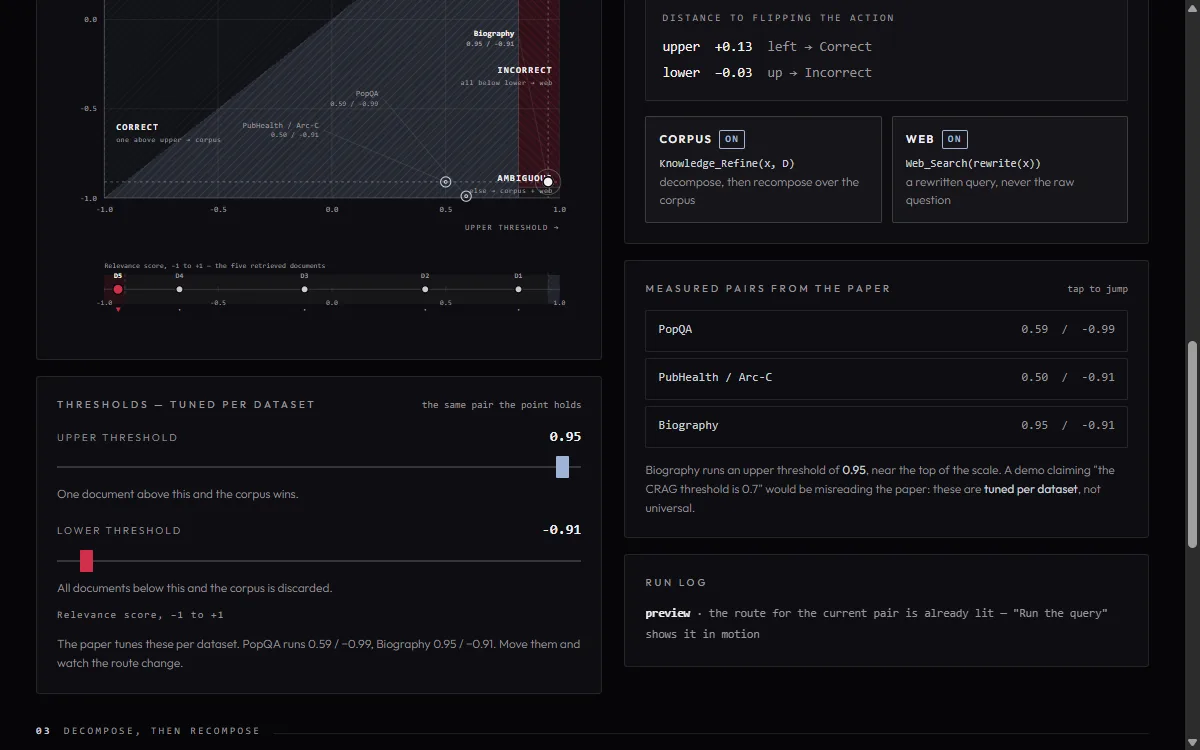
Retrieval That Checks Itself is an interactive demo made in house by SCORVIA, not a client delivery. It shows corrective retrieval: a grader scores each found document before the answer is written, and the scores decide whether the answer draws on the documents, on a web search with a rewritten question, or on both. It runs in your browser at /demos/crag/.
- Type
- Studio piece, interactive demo
- Year
- 2026
- Inside
- Five documents, two thresholds, three states
- Runs in
- Your browser, nothing to install
What corrective retrieval means
Ask a search system for the nearest documents and it will always find some, but nearest is not the same as right. Corrective retrieval puts a grader between the search and the answer, so every document is scored first and nothing reaches the writer unread.
If at least one document scores high, the answer comes from the documents. If every document scores low, they are discarded and the system searches the web with a rewritten question instead.
What you can do in the demo
The five documents hold fixed relevance scores. Only the threshold pair is live. Colour never carries meaning on its own: regions also carry hatching and documents carry glyphs and labels.
- Run the query: step through the route stage by stage and watch which branch lights up.
- Drag the threshold point: move the upper and lower thresholds on a plane, with the mouse or the arrow keys, and the route taken changes as you move.
- Jump to measured pairs: tap a threshold pair measured in the original research and see where it sends the query.
- Watch the strip pass: a document that passes is cut into strips, each strip scored alone, the weak ones dropped and the rest joined back in their original order.
- Read the run log: each step is written down as it happens.
What the trade costs
The demo states the price plainly. Grading means two model calls per query instead of one, and latency goes from roughly 400 ms to roughly 750 ms, with a search round-trip on top when the documents miss.
What you get for it is answers built only from sentences that earned their place, and answers that can include facts published after your index was built. The mechanism comes from published research; the implementation running on the page is ours.
A studio piece, not a client project
We made this demo in house to show how we think about retrieval, in a form you can operate yourself. It is not a delivery for a client. If you want a retrieval system like this on your own documents, see AI automation or private AI.
Want retrieval you can check?
Tell us what your documents are and who needs answers from them. You get a written scope and a fixed fee before any work starts.